St. Joseph: Patron Saint of the Dying and Solace of the Afflicted

St. Joseph: Patron Saint of the Dying and Solace of the Afflicted
(Given at St Leo’s Catholic Church, Ikeja, Lagos, on Sunday 21st November, 2021)
ST JOSEPH: PATRON OF THE DYING
Both in the Christian Religion and African Tradition, “a good death” is a prerequisite for becoming a saint or an ancestor as the case may be (alongside: good life, progeny and befitting burial in the African Tradition). However, what counts for a good death differs in both traditions. In African Traditions, excluded from good death are: deaths of children or the under-aged, death from dreaded venereal diseases, women dying from childbirth, and those killed by the gods in punishment for their wickedness. Among the Yorubas, for instance, those killed by Sango or Soponno (god of small pox) or Ayelala (god of vengeance) are buried in the evil forest; and their belongings are not inherited by anybody unless the oracle directs otherwise. It is believed that those who die bad death cannot join the ancestors or reincarnate.1 Good deaths on the other hand, include: death by natural causes and death after a ripe old age – as old age is regarded as a blessing from God for a life well spent.2
In the Christian parlance, however, “a good death” is ultimately defined as “dying in the state of grace or dying in the odour of sanctity”; all the pleasant and unpleasant circumstances surrounding it are secondary and inconsequential. For, as the Scripture says, “The just man though he dies young, is at rest, for honorary age comes not with the passing of time nor can it be measured in terms of years. Rather, understanding, this is grey hair, untarnished life, this is ripe old age” (Wis. 4:7-9). Many canonized saints died of serious diseases, tragic accidents, to say nothing of those who suffered the ignominious but glorious death of martyrdom. Christ himself died of crucifixion at the youthful age of thirty three, which for the Africans, is far from being a good death.
St Joseph, as tradition has it, was already a middle-aged man when he married Mary we can put that between 30 and 50 years of age), and he died before Jesus commenced his public ministry at the age of 30, but surely after the events of the Finding of the boy Jesus in the Temple when the latter was 12 years old. On the average then, Joseph would have died anytime between his 50th and 70th year. Whether that was a ripe old age or not is immaterial; the issue is whether he died a good death or not as to be qualified as patron of the dying.
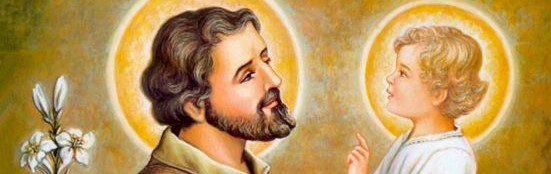
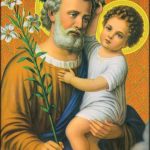
As “a righteous man” in his religious observances and social relations; as a good husband to Mary and a good “father” to Jesus” and an astute defender and guidance of the Holy Family of Jesus, Mary and Joseph, Joseph surely died a good and happy death. On the one hand, death, we know, is not something “unusual”, and so, without some spectacular happenings accompanying it, does not make a good content for any breaking news. On the other hand, we all know the agile speed with which bad news travel farther than good news. So, that the death news of St Joseph was not reported in the New Testament is not anything baffling – that of Mary too was not reported, all the focus was on Jesus, and rightly so. But tradition has it that he died a natural and peaceful death in the odor of sanctity in the arms of Jesus and Mary – the happiest death anyone can think or dream of. This is what more than qualified Joseph to be the Patron of the dying.
The “coming in” and “passing out” of life is very important; and so we all pray to die well, strengthened by the presence and comfort of our loved ones; and Joseph enjoyed the best of this. We now understand deeper why Mary had to stay by the cross of Jesus until he breathed his last (cf. John 19:25-30), in order to give to Jesus the presence and last support she and Jesus gave to Joseph. Joseph also died a natural and peaceful death, not as a result of accident or sickness or crucifixion or in battle or public execution or in terrorist attack, or any violent death. Can anyone ask for more in terms of a happy death? It is in virtue of this that the Church has approved for the faithful many “Prayers to St Joseph” for a happy death. The one I love most is the one that brings all the three persons of the Holy Family together – as if to remind us that Joseph died in the arms of Jesus and Mary:
“Jesus, Mary and Joseph, I give you my heart and my soul.
Jesus, Mary and Joseph, assist me in my last agony.
Jesus, Mary and Joseph, may I breath forth my soul in peace with you”.
It is a prayer we should say daily especially on going to bed and when going out on a journey – near or far. But dying a happy or holy death presupposes living a good life; for anyone who does not live a good life cannot really be said to have died a good death. One is the foundation of the other. And this is where lie the greater relevance of this office of St Joseph as the Patron of the dying to us. We should invoke him to help us live a holy life so as to die a holy death; by striving to imitate his heroic virtues.
ST JOSEPH SOLACE OF THE AFFLICTED
The Bible encourages us to pray for one another (Eph.6:18, James 5:16); and we read in the ‘Catechism of the Catholic Church’ that “the Church recognizes the power of the Spirit of holiness within her and sustains the hope of believers by proposing the saints to them as models and intercessors”.3 So, like the African Ancestors, Christian saints serve as intercessors for the living. The faithful rightly seek the assistance of their elder brothers and sisters in the faith who now serve as their benefactors, having become co-heirs with Christ and been “put in charge of many things” (Mt.25:21). On entering into the joy of their Divine Master, “they do not cease to intercede with the Father for us, as they proffer the merits which they acquired on earth…So, by their brotherly concern is our weaknesses greatly helped”.4
Some saints are noted and specially invoked for particular favours. St. Anthony of Padua, for instance, is specially invoked as restorer of lost articles; St. Christopher, for journey mercies; St. Benedict of Nursia, for exorcism and deliverance from evil powers; St. Thomas Aquinas for wisdom and academic success’ St Rita and St Jude for difficult and impossible cases, and so on. Among others titles, St Joseph is rightly invoked as “Solace of the afflicted” – of course he is not the only one thus invoked. But what qualifies him for such titles are certain data of Divine Revelation relating to “affliction” that we read of him in the Scripture – which the prayerful reflection of the Church over the centuries has enriched with pious details and applications. These “data of afflictions” can be grouped into two: those St Joseph suffered himself; and those in which he came to rescue the situation.
On those he suffered himself, no one can overlook the psychological disturbance and painful agony Joseph underwent upon learning that Mary his betrothed was pregnant (cf. Matt. 1:18-25). He had first to bear with the pain of having “an unfaithful wife” who supposed committed adultery; then, he had to wrestle to reconcile himself with the fact that the Virgin Mary, the holiest woman anyone could think of, could do such a thing. It was a crushing double-blow for St Joseph; and if he could amicably undergo the experience, it tells much of his strength of character and the grace of God in him. Many of us too find ourselves in similar situations, we find it difficult to reconcile the facts of our experiences in life with the doctrine we have come to belief or the values and principles we uphold in life. In such situations, we find ourselves in similar shoes of confusion and agony with St Joseph; and we can only settle down for the lesser evil while waiting upon the Lord to intervene mightily (He settled for divorcing Mary in secret and he went to bed with this in mind, waiting upon the Lord – Matt. 1:18-21). Who else would be a better solace of the afflicted in such situations; in fact, we can also apply to him the words the Letter to the Hebrews applied to Jesus that we do not have a high priest who is unable to sympathize with our weaknesses but one who has been afflicted like us in every way but did not sin” (Heb. 4:15); for Joseph has indeed passed through similar affliction we suffer today, and he can better help us to scale through on top of the situation.
On those in which he came to the rescue the situation, we can cite how with little or no time to prepare, he had to rescue and transport Mary and the Baby Jesus to Egypt when Herod was after his life (cf. Matt. 2:13-18). Recall that he had to travel in the cover of the night, through forest and jungles, with dangers from wild animals and bandits who could dispossess, wound or even kill them. What more, he was not travelling from Galilee to Rome or any place of relaxation but to Egypt, the land of slavery, where their forefathers were slaves for over 400 years. While on such dangerous mission with no hope of warm reception or soft landing where he was going, we could imagine St Joseph singing our Catholic Hymn Book no. 302/ 266:
“Oh, the future lies before me / And I know not where I’ll be.
But where’er my path be leading / Saviour keep my heart with Thee”.
 Without gainsaying, therefore, just as Jesus and Mary, and even God the Father, could count on the protection and provision of Joseph for the Holy Family, we too can count on him, now that he is more powerful with God, as our confident protector and rescuer in time of affliction of any kind.
To him we convincingly and confidently call upon: ST JOSPEH, PATRON OF THE DYING AND SOLACE OF THE AFFLICTED, PRAY FOR US!!
Rev. Sr. Justina Ojo, EHJ
Notes:
1. Anthony Echekwube has done a most scholarly work in which he reinterpreted the common understanding of reincarnation in African worldview and substituted the term with the term “Regeneration” as better expressing the Africa belief in life after death. (Anthony Echekwube. Inaugural Lecture, 2002/2003, Ambrose Alli University.
2. Awolalu, J.O & Dopamu P.A. West African Traditional Religions: p. 254
3. Catechism of the Catholic Church: no 828
4. Lumen Gentium: no 49