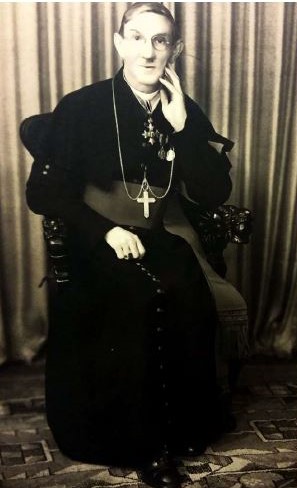
Archbishop Leo Hale Taylor
Archbishop Leo Hale Taylor
Served from: April 18, 1950 to October 27, 1965
Born: September 29, 1889 in Duluth (USA) of American parents
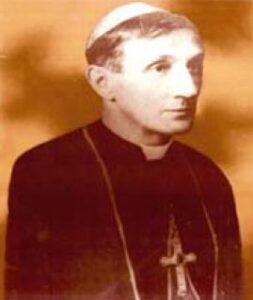 Archbishop Leo Hale Taylor was born in Minnesota, in the diocese of Duluth, U.S.A., on 27 September l889. Leo’s father was a travelling photographer from England, while his mother came either from Northern Ireland or from Sligo in the Republic of Ireland. His younger brother, Claude, became a member of the Society, serving most of his life in African-American parishes in Southern Illinois. Leo studied at St. Joseph’s College, Wilton, Cork. Leo belonged to the first group to study in the Society’s seminary at Blackrock Road, Cork, which opened its doors in 1909. He was admitted as a member of the Society of African Mission, SMA, on 21 October 1911 and was ordained a priest in St. Joseph’s church, adjoining the seminary, by Bishop Daniel Cohalan, auxiliary bishop of Cork, on 21 June l9l4.
Leo was retained in Cork after his ordination. He taught canon law in the seminary from September 1914, for a year, and then was a tutor in Wilton between l9l5-l920. Leo was also the founder and first editor of the African Missionary, the Province’s monthly journal, first published in 1914. It was to become Ireland’s first missionary magazine of the new era. He used the pages of the African Missionary to welcome the foundation of the new Society of St. Columban and, characteristically, took an immediate and active interest in the new nationalist movement.
Leo was appointed to the Vicariate of the Bight of Benin, a vast jurisdiction in south western Nigeria with its headquarters at Lagos. His first appointment, given him by Bishop Ferdinand Terrien, the Vicar Apostolic, was to Holy Cross mission, the oldest station in Nigeria, founded in 1868. Leo was given special responsibility for the schools attached to Holy Cross – a boys’ ‘preparatory’ secondary school with 60 pupils, an elementary boys school with 1,295 pupils and a girls’ elementary school with 547 8 pupils. Leo acquitted himself well in this work and in 1924 he was transferred to the staff of St. Theresa’s minor seminary, at Oke Are, Ibadan. This seminary provided secondary education for seminarians mainly from the south and west of Nigeria, but also from parts of the north.
In 1928 Bishop Terrien opened a ‘full’ secondary college in Lagos, St. Gregory’s College, appointing Leo as ‘founder- principal’. St. Gregory’s College, was the first Catholic secondary college in Nigeria, beginning with a pupil intake of 90 students and within a short time increasing the numbers to some 300. Leo remained in charge of St. Gregory’s until l934.
On 26 February 1934, on the death of Bishop Thomas Broderick, vicar apostolic of Western Nigeria, Leo was nominated to succeed him. This vicariate was the first mission in Nigeria to be entrusted to the Irish Province (in 1918). Leo was consecrated bishop at Asaba (his title was bishop of Vartane) on 26 June 1934. The consecrating prelate was his confrere Bishop Francis O’Rourke (who had succeeded Bishop Terrien in 1930) assisted by Bishop William Porter of the Gold Coast (Ghana) and Bishop Charles Heerey C.S.Sp. of Onitsha. Leo brought with him to this fast-growing mission, a considerable knowledge of the educational apostolate, but also a great enthusiasm for pioneering work, for trekking, for pushing out the frontiers of evangelization. He travelled regularly to the more remote districts of his mission. In road- less parts of Benin, Warri and Kabba provinces, he could be seen cycling along bush paths to administer confirmation in towns and villages which had never before seen a Catholic prelate.
On the death of Bishop Francis O’Rourke, Leo was transferred to the Lagos vicariate from June l939 and, on the erection of the vicariate into the Archdiocese of Lagos, in June 1950, he was appointed Archbishop. He occupied this post until he retired from office early in July l965 (being then nominated titular archbishop of Madito). Leo Taylor took over the Lagos jurisdiction on the eve of the Second 9 World War.
His Personality: Archbishop Leo Hale Taylor was a man who had no favourites. He treated everyone equally with the same rather mordant humour. It was said that if he had lived, he would have been the only person able to avert the Nigerian civil war – because he knew all the principal personalities intimately and was respected by them. He inspired great loyalty among his men. He was also highly esteemed by his fellow S.M.A. bishops who elected him their delegate to the General and Provincial Assemblies of l958.
His Spirituality: As we recall in gratitude, the enormous energy, apostolic labours and zeal of Leo Hale Taylor, we wonder from where he got the strength to carry on his mission. It is obvious: it is from The Eucharist! Leo Hale Taylor had a robust interior life of the spirit. Jesus, fully present in the Blessed Sacrament, was Leo Hale Taylor’s love. He loved contemplating Jesus in the Eucharist—the same Jesus that inspired and nourished his active apostolic engagements and encounters with people. Without such an indispensable personal and deep familiarity with the Eucharistic Jesus in prayer, priestly and religious life would make little meaning, if not difficult to live and sustain. Either as a pioneer principal of St. Gregory College or as a pioneer Archbishop of Lagos, he must have had his own down moments, trials and troubles. As has been put succinctly, Leo Hale Taylor brought all his troubles, and they were many, to the Tabernacle. There he found all the consolation he wanted. He continually preached this devotion to the Blessed Sacrament to his priests and people.
Leo Hale Taylor was a pastor to the core. He was a man of great vision and was committed to his mission. He was available and accessible to his priests, the religious and the laity alike. He not only listened carefully and patiently, he was also caring, sympathetic and empathetic. He had a good rapport with everyone, irrespective of race, nationality, ethnicity or social status. He made friends across religious groups—with non-Catholic Christians, “pagans,” (EHJ; Biography of Leo Hale Taylor; 2015, p. 17). Leo Hale Taylor “loved prayer. He loved the Mass and was devoted to the Holy Eucharist.” (Biography, p. 16) 23 agnostics and Moslems. In fact, his lawyer for many years, Mr. B. Augusto, was a Moslem. Leo Hale Taylor’s singular desire was to serve the Lord by building up the local church. He put much trust and confidence in Divine Providence, frequently and for prolonged periods of time abandoning himself before the Eucharistic Jesus.
On Wednesday October 27, 1965 at 6:30p.m., Archbishop Leo Hale Taylor passed on to his eternal reward, exactly a month after his 76th birthday. He died in Lagos, Nigeria, He was fifty-one years a Priest and thirty-one years a Bishop. He was buried on November 2, 1965, the day he himself said he would be buried. So ended the earthly sojourn of this great missionary to the Western Coast of Nigeria – Archbishop Leo Hale Taylor, the first Archbishop of the Archdiocese of Lagos and the Founder of the institute of the Sisters of the Eucharistic Heart of Jesus.
He was buried on November 2, 1965, the day he himself said he would be buried. So ends the earthly sojourn of this great missionary to the Western Coast of Nigeria – Archbishop Leo Hale Taylor, the first Archbishop of the Archdiocese of Lagos and the Founder of the Institute of the Sisters of the Eucharistic Heart of Jesus. (A Biography of Archbishop Leo Hale Taylor, S.M.A., Founder of the Institute of the Sisters of the Eucharistic Heart of Jesus, Oghene Prints Limited, Nigeria 2015, 18-22).
Read more about him from the book: THE LIFE AND WORKS OF ARCHBISHOP LEO HALE TAYLOR, SMA (A Biography of the Founder of the Institute of the Sisters of the Eucharistic Heart of Jesus and the first Archbishop of Lagos Archdiocese)